Introduction
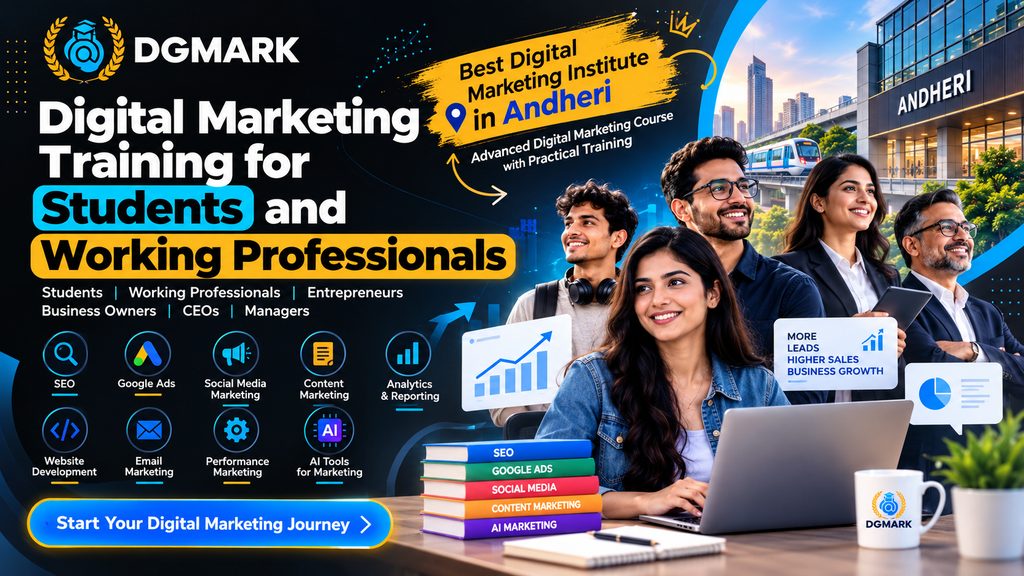
Digital Marketing Training for Students and Working Professionals helps learners develop the skills needed to explore marketing careers, improve business visibility, and generate online leads. DG Mark Institute is an option for learners searching for the Best Digital Marketing Institute in Andheri or an Advanced Digital Marketing Course in Mumbai. Whether you are a student, working professional, CEO, manager, freelancer, or small business owner, learning SEO, Google Ads, social media marketing, website development, performance marketing, and AI-powered marketing can help you understand how businesses attract customers and grow online.
Today, having a website or social media account is not enough to build a strong online presence. Businesses need a clear digital marketing strategy to reach the right audience, build trust, generate enquiries, and convert potential customers into sales. Digital marketing skills can help professionals understand these processes and make better decisions about online promotion.
DG Mark Institute offers digital marketing training for learners with different career and business objectives. By learning important marketing channels and practising relevant skills, learners can prepare for employment opportunities, explore freelancing, or understand how to promote their own businesses.
In this guide, we will explain the benefits of digital marketing training, the skills covered in an advanced course, career opportunities, and how digital marketing knowledge can support business growth.
What Is Digital Marketing Training and Why Is It Important?
Digital marketing training teaches people how to promote businesses, products, and services using online platforms. These include search engines, websites, social media networks, email, and paid advertising platforms.
For example, when someone searches Google for a service, watches a product video on Instagram, or clicks an online advertisement, they interact with digital marketing.
Businesses use these channels to increase visibility, connect with potential customers, promote their products, and measure marketing performance.
A structured digital marketing course can introduce learners to the following areas:
- Search Engine Optimization (SEO): Improve a website’s visibility in organic search results.
- Social Media Marketing: Create content and build relationships with audiences on social platforms.
- Google Ads: Reach potential customers through paid advertising.
- Meta Ads: Promote products and services on Facebook and Instagram.
- Website Development: Build websites and landing pages that support business objectives.
- Content Marketing: Create useful blogs, videos, guides, and social media content.
- Email Marketing: Communicate with prospects and customers through relevant email campaigns.
- Performance Marketing: Measure advertising performance using leads, sales, conversions, and other KPIs.
- Marketing Analytics: Understand campaign data and identify opportunities for improvement.
- AI-Powered Marketing: Use AI tools to support research, planning, content creation, and analysis.
These skills are useful because businesses increasingly need people who understand both marketing strategy and practical implementation.
For students, this knowledge can help prepare for entry-level roles. For working professionals, it can support career development. For entrepreneurs, it can help them understand how to attract customers and evaluate their marketing investments.
Why Choose DG Mark Institute for Digital Marketing Training?
Choosing a digital marketing institute requires more than comparing advertisements or course fees. Learners should evaluate the curriculum, practical assignments, trainer experience, learning support, and relevance of the skills being taught.
DG Mark Institute’s published course information describes training in important digital marketing disciplines, including SEO, social media marketing, advertising, content marketing, and AI tools. Prospective learners can use these details as a starting point when comparing available programmes.
Practical Learning and Assignments
Digital marketing is a practical field. Understanding concepts is important, but learners also need opportunities to apply them.
For example, an SEO assignment might involve researching keywords, analysing a website, improving page titles, and preparing a content plan. A paid advertising assignment might involve selecting keywords, writing advertisements, and planning a campaign budget.
Practical work can help learners understand the steps involved in managing marketing activities.
Before enrolling, ask which projects are included, whether learners receive individual feedback, and whether they will build a portfolio during the course.
Learning Multiple Digital Marketing Skills
Businesses often use several marketing channels together.
SEO can attract organic traffic, Google Ads can target people with specific search intent, and social media can help a brand build awareness. A well-designed landing page can then encourage visitors to submit an enquiry.
Learning how these channels work together can help students understand the complete customer journey rather than treating each platform as a separate activity.
Understanding Industry-Relevant Tools
Digital marketers work with tools for keyword research, website analytics, advertising management, content creation, and performance reporting.
Learning how these tools work can help learners understand professional marketing workflows. However, tools change regularly, so it is equally important to understand the underlying marketing principles.
Career Preparation and Portfolio Development
A digital marketing portfolio can demonstrate practical knowledge to potential employers or clients.
It might include a sample website, SEO audit, keyword research report, social media content calendar, advertising campaign plan, or performance dashboard.
DG Mark Institute’s published course information discusses career support and practical learning opportunities. Before enrolling, confirm the current availability and conditions of internship, placement, and portfolio support directly with the institute.
Who Should Join a Digital Marketing Course?
Digital marketing training can be useful for people at different stages of their careers. The right course depends on whether your goal is to find employment, improve professional skills, manage a business, or offer marketing services to clients.
Students and Freshers
Students who want to enter the digital marketing industry can use training to develop an understanding of SEO, social media, content creation, advertising, and analytics.
Practical assignments can help them build confidence and create examples of their work.
Possible career paths include:
- Digital Marketing Executive
- SEO Executive
- Social Media Executive
- Content Marketing Executive
- Google Ads Executive
- Performance Marketing Trainee
The opportunities available will depend on practical ability, communication skills, experience, and employer requirements. Completing a course can provide a foundation, but it does not guarantee a job.
Working Professionals
Working professionals may want to change careers, improve their existing skills, or understand how digital channels support their current roles.
For example, a sales professional can learn how online lead generation works. A traditional marketing executive can develop knowledge of digital advertising, while a business development professional can learn how online campaigns support customer acquisition.
When choosing a course, working professionals should consider the timetable, teaching format, practical workload, and opportunities to revise lessons.
CEOs and Managers
CEOs, managers, and business leaders need to understand how marketing contributes to business objectives.
They may not need to manage campaigns themselves, but digital marketing knowledge can help them evaluate proposals, review performance reports, and understand how marketing budgets are used.
Important metrics include cost per lead, conversion rate, customer acquisition cost, and return on advertising spend.
Understanding these metrics helps decision-makers ask more useful questions and assess whether marketing activities are contributing to business growth.
Business Owners and Entrepreneurs
Small business owners often need to manage sales, customer relationships, operations, and marketing simultaneously.
Digital marketing training can help them understand how customers discover businesses online and how different channels can support lead generation.
For example, a local service provider might use local SEO to improve visibility in relevant searches. An online store might use product advertising, while a consultant might publish educational articles to demonstrate expertise.
Business owners can use this knowledge to manage selected activities themselves or work more effectively with a professional marketing agency or freelancer.
Freelancers and Aspiring Agency Owners
People interested in freelancing can learn how to provide services such as SEO, social media management, website development, and paid advertising.
However, building a successful freelance business requires more than knowing how to use marketing tools.
Freelancers must also understand client requirements, prepare proposals, define deliverables, report results, and communicate expectations clearly.
A portfolio of practical projects can help demonstrate capabilities to prospective clients.
What Will You Learn in an Advanced Digital Marketing Course?
An Advanced Digital Marketing Course can introduce learners to the techniques used to plan, execute, and measure online marketing campaigns.
The exact syllabus depends on the programme, so check the current DG Mark Institute curriculum before enrolling. The following topics are important areas to understand when comparing digital marketing training options.
1. Search Engine Optimization (SEO)
SEO involves improving a website so that search engines can understand its content and users can find relevant information.
Important topics include:
- Keyword research and search intent
- On-page SEO and heading structure
- Technical SEO fundamentals
- Internal linking
- Content optimization
- Local SEO
- Google Search Console and website performance analysis
For example, a business offering professional services in Andheri can create useful service pages that explain its expertise, service area, customer benefits, and contact options.
The content should answer genuine customer questions rather than repeat the same keyword unnaturally.
SEO takes time and depends on competition, website quality, relevance, and other factors. No training course or freelancer can responsibly guarantee a specific Google ranking.
2. Social Media Marketing
Social media marketing helps businesses reach relevant audiences through content, community engagement, and platform-specific strategies.
Learners may explore content calendars, audience research, post design, reels, carousel posts, captions, and engagement analysis.
For example, a B2B company may publish educational content about industry challenges, while a retailer might use product demonstrations and customer stories.
A strong social media strategy starts with a clear objective. A business looking for enquiries needs a different approach from one focused primarily on brand awareness.
3. Google Ads and Paid Advertising
Google Ads helps businesses reach potential customers through paid placements, including search advertising.
A course may cover keyword selection, campaign structure, ad copy, bidding, budget allocation, conversion tracking, and landing-page optimization.
Imagine a training institute wants to attract students searching for digital marketing courses in Mumbai. It can create relevant advertisements and direct interested users to a landing page containing course information and an enquiry form.
Campaign performance should be measured through meaningful outcomes, not clicks alone. Businesses need to assess the quality of enquiries and the number of customers ultimately acquired.
4. Meta Ads for Facebook and Instagram
Meta Ads allows businesses to promote products and services to relevant audiences using supported advertising formats.
Important skills include campaign planning, audience selection, creative testing, lead forms, budget management, and conversion measurement.
For instance, a local business can run a lead-generation campaign to collect enquiries from potential customers.
The business should follow up with those leads, assess their relevance, and measure how many become paying customers.
5. Website Development and Landing Pages
A website gives businesses a central place to explain their services, demonstrate credibility, and encourage visitors to take action.
Digital marketing training may include website planning, WordPress, landing-page structure, mobile usability, calls to action, and basic conversion optimization.
A good landing page should communicate the offer clearly, answer important questions, and make the next step easy.
For a training institute, that action might be requesting course details. For a freelancer, it might be booking a consultation or requesting a quotation.
6. Content Marketing and Copywriting
Content marketing involves publishing useful information that attracts and educates a target audience.
Common formats include blogs, service pages, social media posts, videos, email newsletters, and downloadable guides.
Copywriting helps businesses explain their value and encourage readers to take an appropriate next step.
For SEO, content should be useful, accurate, and aligned with search intent. Repeating keywords excessively can make an article difficult to read and reduce its usefulness.
7. Performance Marketing and Analytics
Performance marketing focuses on measuring results against defined objectives.
Common KPIs include:
- CTR (Click-Through Rate): The percentage of impressions that result in clicks.
- CPC (Cost Per Click): The average cost paid for a click.
- CPL (Cost Per Lead): The average cost of generating a lead.
- CPA (Cost Per Acquisition): The average cost of acquiring a customer or another defined conversion.
- Conversion Rate: The percentage of users who complete a desired action.
- ROAS (Return on Ad Spend): Revenue attributed to advertising divided by advertising spend.
Understanding these metrics helps marketers identify where campaigns may need improvement.
For example, an advertisement may receive many clicks but generate few enquiries. The issue could relate to targeting, search intent, the offer, the landing page, or conversion tracking.
8. AI Tools and Modern Search Optimization
AI tools can assist with research, brainstorming, content planning, reporting, and repetitive marketing tasks.
However, AI-generated content still requires human review for factual accuracy, originality, relevance, and usefulness.
Learners should also understand three related concepts:
- AEO (Answer Engine Optimization): Making content clear and structured so it answers users’ questions effectively.
- GEO (Generative Engine Optimization): Improving the clarity, credibility, and discoverability of content in generative search experiences.
- AIO (AI Optimization): A broad term for using AI-assisted processes to support marketing and optimization activities.
Useful practices include descriptive headings, direct answers, accurate business information, original examples, and credible sources.
These techniques can improve content quality and discoverability, but they cannot guarantee placement in featured snippets or AI-generated responses.
How Can Digital Marketing Training Help Business Owners Generate More Leads?
For entrepreneurs and small business owners, the value of digital marketing lies in connecting marketing activities to business results.
Increasing traffic or social media followers may be useful, but the ultimate objective is often to attract relevant prospects, generate enquiries, convert customers, and improve revenue.
Understand Your Target Audience
Start by identifying the customers most likely to need your product or service.
Consider their location, requirements, budget, challenges, and buying behaviour.
A local business may need location-specific content, while a company serving customers across India may need a broader strategy.
Improve Your Online Visibility
A clear website, useful service pages, consistent business details, and relevant content can help customers discover and evaluate your business.
Local businesses can also maintain an accurate Google Business Profile and encourage genuine customer reviews.
Select the Right Marketing Channels
Different businesses need different strategies.
- Local service businesses may benefit from local SEO and Google Ads.
- B2B companies may focus on educational content, LinkedIn, and lead-generation campaigns.
- Retailers may combine product pages, social media, and paid advertising.
- Consultants and freelancers may use service pages, blogs, and enquiry forms.
The best combination depends on your audience, competition, budget, and sales process.
Track Enquiries and Sales
Measure how many people contact your business, how many enquiries are qualified, and how many become customers.
This information helps you understand which campaigns are producing valuable results.
Digital marketing training can help business owners understand these processes, whether they manage campaigns internally or hire an external marketing professional.
Can Digital Marketing Training Help You Become a Freelancer?
Yes. Training can provide a foundation for offering digital marketing services, but successful freelancing also requires practical experience, client communication, and business management.
Start by learning one or two services in depth. For example, you might focus on SEO audits and on-page optimization or social media content planning and management.
Develop sample projects, document your process, and create a portfolio that demonstrates your skills.
You should also learn how to identify client needs, set realistic expectations, prepare proposals, define deliverables, and report campaign results.
Businesses generally want to understand how your work can help them reach their objectives. Explaining your services in terms of visibility, enquiries, conversions, and sales can make your proposals more useful.
Before choosing a training programme, check whether it includes practical assignments, portfolio development, and guidance relevant to your career goals.
How to Choose the Best Digital Marketing Institute in Andheri?
Choosing the right institute is an important step for anyone who wants to develop digital marketing skills. Students may want to prepare for their first job, while working professionals may want to upgrade their skills. Business owners and entrepreneurs may be more interested in learning how to generate leads, promote services, and improve their online presence.
When comparing institutes, look beyond promotional claims and evaluate the learning experience, course curriculum, practical assignments, and career support.
Check the Course Curriculum
A good digital marketing course should cover the essential skills required to understand modern online marketing. These may include SEO, social media marketing, Google Ads, Meta Ads, website development, content marketing, analytics, and AI tools.
The curriculum should also explain how these channels work together. For example, learners should understand how SEO attracts visitors, how landing pages convert visitors into enquiries, and how analytics measures the results.
Before enrolling at DG Mark Institute, review its latest syllabus and confirm which modules are included in the course you are considering.
Look for Practical Training
Digital marketing requires practical experience. Ask whether the course includes assignments, website optimization, campaign planning, content creation, and performance reporting.
Practical projects can help learners understand real marketing challenges and build examples of their work for interviews or client discussions.
Understand Career Support
If your goal is to find employment, ask about resume preparation, interview practice, internship opportunities, and placement assistance.
If your goal is freelancing, ask whether the programme helps you understand client communication, proposal preparation, service pricing, and portfolio development.
Career support can be valuable, but employment depends on your skills, performance, experience, and the opportunities available.
Compare Fees, Duration, and Schedule
Compare the total course fee, duration, teaching format, class timings, and additional costs before making a decision.
Working professionals may need flexible timings, while students may prefer classroom learning and regular practical assignments.
Confirm the latest fees and admission details directly with DG Mark Institute because course offerings and prices can change.
What Career Opportunities Are Available After Digital Marketing Training?
Digital marketing offers several career paths because businesses across different industries use online channels to promote their products and services.
The right career depends on your interests, practical skills, communication ability, and professional goals.
Digital Marketing Executive
A digital marketing executive helps plan and implement online marketing activities. Responsibilities may include coordinating social media content, updating website pages, supporting advertising campaigns, and preparing performance reports.
This role can provide a broad introduction to digital marketing for freshers.
SEO Specialist
An SEO specialist works on improving a website’s visibility in organic search results.
Typical responsibilities include keyword research, website audits, on-page optimization, internal linking, content recommendations, and performance monitoring.
People who enjoy research, problem-solving, and analysing website performance may find this role interesting.
Social Media Manager
A social media manager plans and manages a brand’s presence on relevant social platforms.
The role can involve content calendars, creative planning, caption writing, publishing, audience engagement, and reporting.
Strong communication skills and an understanding of audience behaviour are useful for this position.
Google Ads and Performance Marketing Specialist
Paid advertising professionals plan and manage campaigns designed to achieve objectives such as leads, purchases, registrations, and website enquiries.
Their responsibilities may include keyword selection, audience targeting, budget management, ad testing, conversion tracking, and performance analysis.
An understanding of metrics such as CPC, CPL, CPA, conversion rate, and ROAS is important.
Content Marketing Specialist
Content marketing professionals create useful information that attracts and educates a target audience.
They may write blog posts, develop website content, prepare social media campaigns, and coordinate videos or other creative materials.
Knowledge of SEO and audience research can help content professionals produce more relevant material.
Freelance Digital Marketer
Freelancers provide digital marketing services to businesses on a project or ongoing basis.
They may specialize in SEO, social media management, Google Ads, Meta Ads, website development, or content marketing.
Freelancing provides flexibility, but income is not guaranteed. Building a sustainable freelance business requires a strong portfolio, client relationships, consistent delivery, and effective communication.
Digital Marketing Consultant or Agency Owner
Experienced marketers may eventually offer strategic consulting or establish an agency.
This path can involve developing marketing strategies, managing client accounts, coordinating specialists, preparing proposals, and evaluating business results.
Training can provide a foundation, but practical experience and business management skills remain essential.
How Can Business Owners Use Digital Marketing to Grow Their Business?
Digital marketing is useful not only for people seeking employment. It can also help business owners understand how to attract customers and make informed marketing decisions.
For CEOs, managers, entrepreneurs, and small business owners, the main objective is usually to connect marketing activity with measurable business outcomes.
Build a Strong Website
A website should clearly explain what a business offers, who it serves, and how customers can make contact.
Important elements include service descriptions, useful content, mobile-friendly design, clear calls to action, and easy-to-use enquiry forms.
For example, a digital marketing company can create separate pages for SEO, social media marketing, website development, and paid advertising. Each page can explain the service, answer customer questions, and encourage relevant enquiries.
Improve Local Search Visibility
Local SEO can help businesses become more discoverable when people search for services in a particular area.
Businesses serving Mumbai may create useful, location-relevant pages for areas such as Andheri, Goregaon, and Borivali when those locations genuinely match their service areas.
Maintaining accurate business information and a complete Google Business Profile can also support local visibility.
Avoid creating repetitive pages that simply replace one location name with another. Each location page should provide genuine value to users.
Use Social Media to Build Trust
Social media gives businesses opportunities to demonstrate expertise, answer common questions, share useful information, and communicate with potential customers.
For example, a service provider can publish educational reels, explain common customer problems, share project insights, and answer frequently asked questions.
Consistent, relevant content can help audiences understand the business before they make an enquiry.
Use Paid Advertising to Reach Potential Customers
Google Ads can help businesses reach people searching for specific products or services. Meta Ads can support awareness, engagement, and lead generation through suitable campaign formats.
Before investing in advertising, businesses should define their target audience, budget, offer, and desired outcome.
They should also ensure that landing pages work properly and conversion tracking is configured correctly.
Measure Marketing Performance
Business owners should evaluate more than impressions and clicks.
Useful measures include qualified leads, cost per lead, conversion rate, customer acquisition cost, sales revenue, and return on advertising spend.
Tracking these figures can help businesses understand which channels contribute to their goals and where improvements are needed.
Should You Hire a Digital Marketing Freelancer or Learn Digital Marketing Yourself?
The answer depends on your objectives, available time, budget, and the complexity of your marketing activities.
When Learning Digital Marketing Makes Sense
Learning digital marketing may be useful if you want to build a new career, develop additional professional skills, or understand how to promote your own business.
Business owners who understand the basics can evaluate proposals, review reports, and make better decisions when working with marketing professionals.
However, managing every marketing channel independently requires time, practice, and continuous learning.
When Hiring a Freelancer Makes Sense
Hiring a digital marketing freelancer can be useful when you need specialist support but do not want to build an in-house team.
Depending on their expertise, a freelancer may help with SEO, website development, social media marketing, Google Ads, Meta Ads, or lead-generation campaigns.
Before hiring, review the freelancer’s portfolio, services, reporting process, communication practices, and proposed deliverables.
Avoid choosing a provider solely because they promise guaranteed rankings or a fixed number of sales. Marketing outcomes depend on several factors, including competition, budgets, offers, and customer demand.
When an Agency May Be More Suitable
Businesses that need several specialists, coordinated campaigns, or larger-scale marketing operations may prefer an agency.
An agency may offer multiple services under one arrangement, although the level of expertise and account management varies between providers.
The best choice is the one that fits your business requirements, resources, and objectives.
Frequently Asked Questions About Digital Marketing Training
1. Who can join a digital marketing course at DG Mark Institute?
Students, freshers, working professionals, freelancers, entrepreneurs, and business owners may find digital marketing training useful. Check the institute’s current eligibility requirements for the specific programme you want to join.
2. Is digital marketing training suitable for working professionals?
Yes. Digital marketing training can help working professionals upgrade their skills, explore a career change, or understand how online marketing supports sales and business development.
Before enrolling, check the class schedule and learning format to ensure they fit your work commitments.
3. What topics should an advanced digital marketing course cover?
A comprehensive course may include SEO, social media marketing, Google Ads, Meta Ads, website development, content marketing, analytics, performance marketing, and AI tools.
The exact syllabus varies, so review the current curriculum before enrolling.
4. Can I become a freelancer after completing digital marketing training?
Yes, training can provide a foundation for freelancing. You will also need practical experience, a portfolio, client communication skills, and the ability to manage projects and deliverables.
Start with services you understand well and build experience gradually.
5. Can business owners benefit from digital marketing training?
Yes. Business owners can learn how to evaluate marketing strategies, understand campaign metrics, improve their online presence, and identify suitable lead-generation channels.
They can then decide which activities to manage internally and which to outsource.
6. Does a digital marketing course guarantee a job?
No course can guarantee an individual’s employment outcome. Training, practical experience, communication skills, interview performance, and market conditions all influence job opportunities.
Ask the institute about its current placement support and the conditions attached to it.
7. How long does it take to learn digital marketing?
The time required depends on the course, the learner’s starting knowledge, and the amount of practical work completed.
A structured programme can introduce the main concepts, but becoming proficient requires regular practice and continued learning.
8. Is digital marketing useful for small businesses?
Yes. Small businesses can use SEO, social media, websites, email marketing, and paid advertising to reach relevant audiences.
The most appropriate channels depend on the target customers, budget, business location, and sales objectives.
9. What is the difference between SEO and Google Ads?
SEO focuses on improving organic search visibility, while Google Ads uses paid advertising placements to reach relevant audiences.
SEO may take time to produce meaningful results, whereas paid advertising can generate traffic once campaigns are active. Both require relevant content, suitable targeting, and performance measurement.
10. Where can I find digital marketing training in Andheri, Mumbai?
DG Mark Institute lists a training centre in Andheri West, Mumbai, on its official website. Prospective learners can review the course details, confirm the current address, and contact the institute to ask about admissions and available batches.
Official website: https://dgmarkinstitute.com/
Start Your Digital Marketing Journey with DG Mark Institute
Digital marketing skills can help you prepare for new career opportunities, improve your professional capabilities, or understand how businesses attract customers online.
If you are a student, focus on building practical skills and a portfolio. If you are a working professional, choose training that supports your career objectives. If you are an entrepreneur or business owner, identify the marketing skills that will help you make better decisions and generate relevant enquiries.
DG Mark Institute is an option to explore when comparing digital marketing training programmes in Mumbai. Review its latest curriculum, practical projects, fees, duration, and support services before making your decision.
Ready to take the next step? Visit the official website to explore the available programmes and request current course details.
For business owners who need professional marketing support rather than training, consider identifying your immediate needs first, such as SEO, website development, social media management, or paid advertising. Choosing the right approach begins with a clear business objective and a realistic plan.
A strong digital marketing foundation can help you understand the opportunities available and make more informed decisions about your career or business growth.